
Financials
What You Can Bill
The ethics of classifying a charge (billable work, firm overhead, or a client expense) and how Missouri v. Jenkins and ABA Formal Opinion 93-379 draw the lines.
Lawyers love to cite Missouri v. Jenkins for the idea that you “can’t bill a client for clerical work.” It’s one of the most-repeated lines in legal billing, and it’s mostly a misreading. Jenkins isn’t a list of things you can’t charge a client. It’s a fee-shifting case about what a winning party recovers from the other side, and its famous “don’t bill it” line is a single footnote. The rules that actually govern what you charge your own client live elsewhere. The distinction matters, because how you classify a charge is what decides whether it’s reasonable, and reasonableness is the whole game.
What Missouri v. Jenkins Actually Says
The holding runs the opposite way from how it’s usually quoted: paralegal and law-clerk time is recoverable, and at prevailing market rates rather than at cost. The “can’t bill” piece is footnote 10, which carves out one exception: purely clerical or secretarial tasks shouldn’t be charged at a professional rate no matter who performs them, because non-legal work doesn’t become more valuable just because a lawyer did it. That last idea the Court borrowed from an older fee case, Johnson v. Georgia Highway Express.
Strip it down and the principle is simple: clerical work is overhead, and overhead is presumed to be baked into your hourly rate, not charged on top of it.
The Rule That Does the Work
Whether your client can be charged for a given task is a reasonableness question under Model Rule 1.5(a) and a contract question (your engagement letter), informed by, but not controlled by, Jenkins. The workhorse authority is ABA Formal Opinion 93-379. In plain terms, it holds that you bill only the hours you actually worked, you don’t bill the same hour to two clients, you don’t charge full price for recycled work as if it were done fresh, general office overhead is already inside your rate, and out-of-pocket costs are passed through at what they actually cost you.
The Four Kinds of Charge
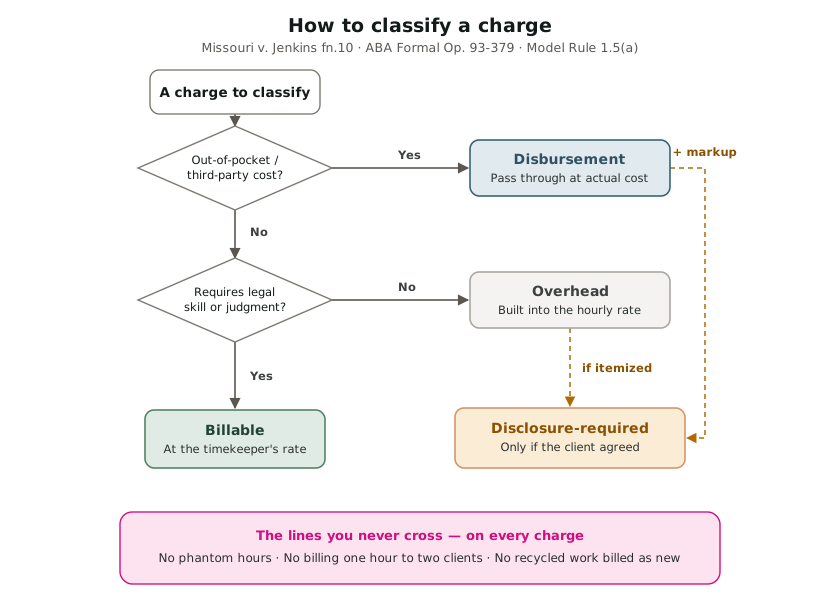
Almost every line on an invoice is one of four things. Naming which one tells you how it can be charged, and whether it can be at all.
| Kind of charge | What it is | How it’s billed | Where the rule comes from |
|---|---|---|---|
| Billable | Work that takes a lawyer’s or paralegal’s training and judgment | At the timekeeper’s rate, for time actually spent | Rule 1.5(a); Jenkins (professional work earns professional rates) |
| Overhead | Clerical and secretarial work, and the cost of running the office | Not charged separately; it’s already inside your hourly rate | Jenkins fn. 10; Formal Op. 93-379 |
| Disbursement | Money you actually pay a third party on the client’s behalf | Passed through at what it cost you, with no markup | Formal Op. 93-379 |
| Disclosure-required | A charge that’s allowed only because the client agreed to it in advance | Only if your engagement letter says so, otherwise not at all | Formal Op. 93-379 (“absent an agreement to the contrary”) |
The fourth kind is the one firms trip over. “Disclosure-required” isn’t a separate kind of cost; it’s the escape hatch. Overhead and disbursements each have a hard default (inside the rate; at cost). The only way to charge them differently (a per-page copy charge, an in-house research fee, a markup) is a clear term your client agreed to up front.
How to Tell Them Apart
When a charge isn’t obvious, walk it down this path:
Guidance, Not Gospel
One caution before you build any of this into a billing habit: the Model Rules and ABA opinions are persuasive, not binding. They bind no lawyer until a state adopts its own version, and the versions differ. Treat the four kinds of charge as a sound framework, but confirm the specifics against your own state’s rule. Pick your state to see the standard your fees are actually measured against:
Across all fifty states the standard sorts into four formulations: most use a reasonableness test (a fee may not be unreasonable); a cluster keep the older “clearly excessive” wording; New York uses “excessive” (with a “definite and firm conviction” test); and California and Texas use the strictest, “unconscionable” (California’s version expressly weighs nondisclosure). The framework is the same everywhere; what shifts is the threshold at which a misclassified or inflated charge crosses the line. For a firm practicing across contiguous states, your neighbors usually match you, unless one of them is a California, Texas, New York, or “clearly excessive” state.
How Outlaw Practice Helps
Outlaw Practice is built around these same distinctions, so classifying a charge correctly is mostly a matter of using the right field.
Mark What's Billable
Every time entry has a billable switch, plus no-charge (it shows on the invoice at $0) and hide from invoice (it drops off entirely). Administrative and clerical work can be logged for the record without ever reaching the client’s bill. See Time Entries.
Log Expenses at Cost
Out-of-pocket costs go in as Expenses, billed at what you paid. There’s deliberately no markup field; a disbursement leaves the firm at cost, which is exactly what Opinion 93-379 expects.
Put Your Terms in Writing
Anything in the “disclosure-required” column belongs in your engagement letter and the case’s Fee Arrangements: the rates, flat fees, and contingency terms the client agreed to up front.
One honest limit: Outlaw Practice doesn’t store the engagement agreement itself; that lives in the client’s file. So for any charge that depends on the client’s consent, your signed letter and your fee arrangements are the source of truth; the app records the numbers, not the agreement behind them.
Sources
The authorities this article rests on. Each links to a freely-available copy of the primary source.
Cases
| Case | What it establishes |
|---|---|
| Missouri v. Jenkins, 491 U.S. 274, 288 n.10 (1989) | Paralegal time is recoverable at market rates; purely clerical work (fn. 10) is overhead, not professional time |
| Johnson v. Georgia Highway Express, Inc., 488 F.2d 714, 717 (5th Cir. 1974) | “Its dollar value is not enhanced just because a lawyer does it” (the source of Jenkins’s footnote-10 reasoning) |
Rules & Ethics Opinions
| Authority | What it establishes |
|---|---|
| Model Rule of Prof’l Conduct 1.5(a) | A lawyer “shall not make an agreement for, charge, or collect an unreasonable fee or an unreasonable amount for expenses” |
| ABA Formal Op. 93-379 (1993) | No phantom hours; no double-billing the same time; no recycled work as fresh; overhead is inside the rate; disbursements at cost absent agreement |
| Tex. Disciplinary Rule of Prof’l Conduct 1.04 | Texas’s stricter “unconscionable” fee standard (the example that the rules vary by state) |